 (1).webp)
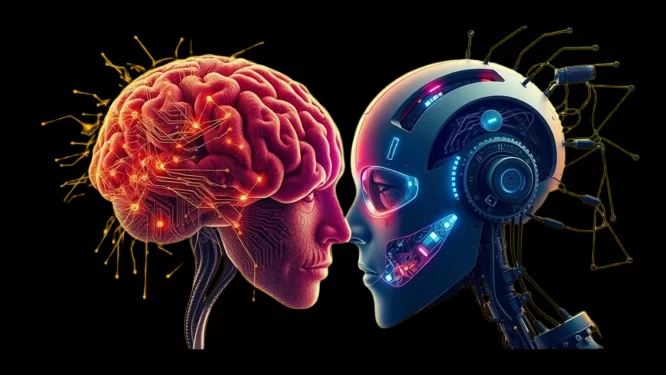
AI vs Human Brain: Key Differences Explained in Intelligence, Learning, and Decision-Making
The comparison between artificial intelligence and the human brain is one of the most discussed topics in modern science and technology. As AI systems become more advanced, many people wonder how close machines are to human intelligence. However, despite similarities in processing information, the human brain and artificial intelligence are fundamentally different systems.
Understanding these differences helps clarify what AI can do, what it cannot do, and how both can coexist in the future.
1. Structure: Biological Brain vs Digital System
The human brain is a biological organ made of approximately 86 billion neurons. These neurons communicate through complex chemical and electrical signals, allowing humans to think, feel, and adapt.
Artificial intelligence, on the other hand, is a digital system built on algorithms and data processing. It operates through mathematical models and computing power rather than biological processes.
Key difference:
- Human brain: Biological, adaptive, self-organizing
- AI: Digital, programmed, data-driven
2. Learning Process
Humans learn through experience, emotion, observation, and interaction with the environment. Learning is often slow but deeply integrated with memory and understanding.
AI learns through training on large datasets using machine learning algorithms. It identifies patterns and applies statistical models to make predictions.
Key difference:
- Human learning: Experience-based and contextual
- AI learning: Data-based and pattern recognition
3. Memory and Storage
Human memory is selective, emotional, and sometimes unreliable. It is influenced by attention, emotion, and time.
AI memory is precise and structured. It stores vast amounts of data without forgetting, unless it is programmed to do so.
Key difference:
- Human memory: Flexible but imperfect
- AI memory: Accurate but non-contextual
4. Creativity and Imagination
The human brain generates creativity through imagination, emotions, cultural influence, and personal experience. Creativity often involves breaking rules and forming new ideas from abstract thinking.
AI generates creative outputs by analyzing existing data and combining patterns in new ways. While impressive, it does not “imagine” in a human sense.
Key difference:
- Human creativity: Emotional, intentional, original experience-based
- AI creativity: Pattern-based and statistical
5. Decision-Making Process
Humans make decisions using logic, emotions, intuition, and past experiences. This makes decision-making flexible but sometimes inconsistent.
AI makes decisions based on predefined algorithms and data analysis. It is consistent and fast but lacks emotional reasoning.
Key difference:
- Human decisions: Emotional + rational mix
- AI decisions: Logical and data-driven
6. Consciousness and Awareness
The human brain is conscious. It is aware of itself, capable of self-reflection, emotions, and subjective experience.
AI has no consciousness. It processes inputs and generates outputs without awareness or understanding.
Key difference:
- Human brain: Self-aware and conscious
- AI: Non-conscious system
7. Adaptability and Flexibility
Humans can adapt to completely new situations, even without prior experience. They can think abstractly and solve unfamiliar problems creatively.
AI is limited to the data and training it has received. It struggles with tasks outside its trained environment unless retrained or updated.
Key difference:
- Human adaptability: High and intuitive
- AI adaptability: Limited to training data
Benefits of AI Compared to the Human Brain
Despite limitations, AI has advantages:
- Faster data processing
- No fatigue or emotional bias
- Ability to analyze large datasets
- High accuracy in repetitive tasks
- Scalability across systems
Advantages of the Human Brain Over AI
The human brain remains superior in:
- Emotional intelligence
- Creativity and imagination
- Moral and ethical reasoning
- Abstract thinking
- Conscious awareness
Will AI Ever Match the Human Brain?
While AI continues to improve rapidly, matching the full complexity of the human brain remains extremely challenging. Intelligence is not only about processing power but also about consciousness, emotions, and lived experience.
Most experts believe that AI will become more powerful in specific tasks but will not fully replicate human general intelligence.
Yorumlar